
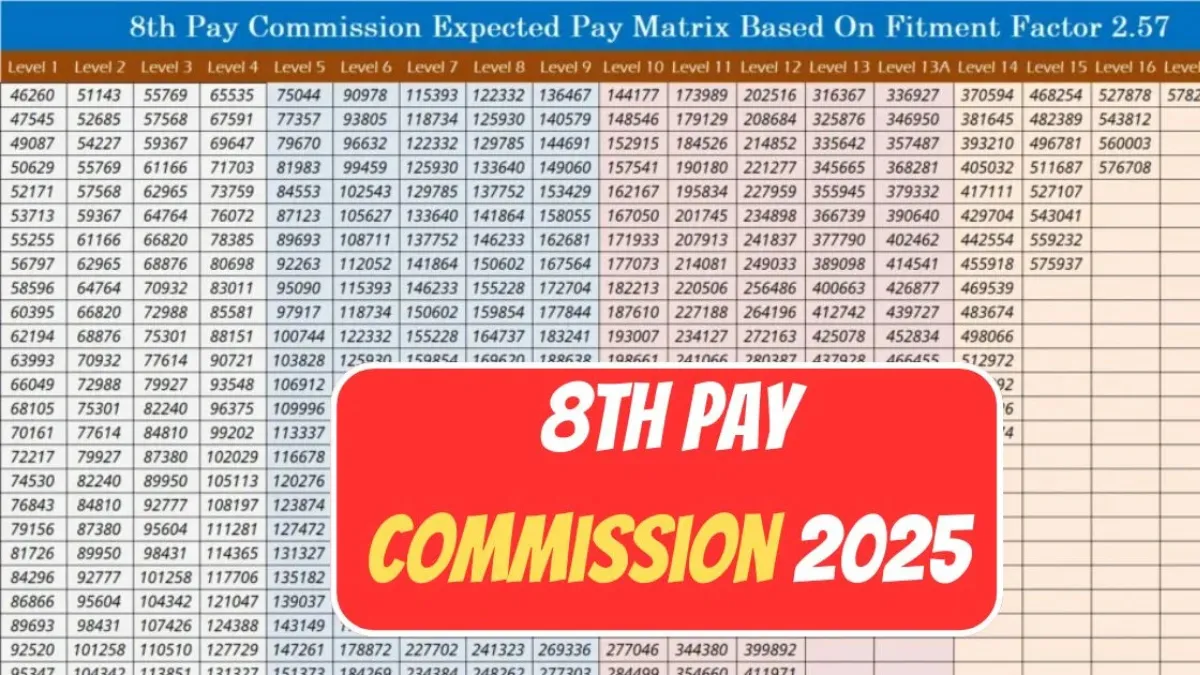
The discussion around the 8th Pay Commission has picked up serious momentum in 2025 as central government employees and pensioners eagerly look forward to the next big salary revision. With rising inflation, higher living costs, and growing demands from employee unions, expectations are high that the government may soon move toward forming the 8th Pay Commission. This update is not just about a pay hike but a complete restructuring of salaries, allowances, and pensions.
What Is the 8th Pay Commission and Why It Matters
The Pay Commission is set up by the central government to review and recommend changes in the salary structure of government employees and pensioners. The 7th Pay Commission was implemented in 2016, and since then, salaries have remained unchanged apart from DA revisions. The 8th Pay Commission is expected to address income gaps, inflation pressure, and demands for fair pay parity across departments.
For nearly one crore employees and pensioners, the 8th Pay Commission could significantly improve monthly income and retirement benefits.
Expected Salary Hike Under 8th Pay Commission
One of the biggest attractions of the 8th Pay Commission is the expected salary hike. Based on previous trends and current discussions, salaries may increase substantially across all pay levels. Experts believe the overall hike could range between 25 percent to 35 percent, depending on the final recommendations.

The increase will be driven mainly by a revised fitment factor and reworked pay matrix. Entry-level employees are expected to see the most noticeable jump in basic pay.
Fitment Factor 2025: How Much Can It Increase
The fitment factor plays a crucial role in determining the new basic salary. Under the 7th Pay Commission, the fitment factor was fixed at 2.57. For the 8th Pay Commission, employee unions are demanding a higher multiplier to match present economic conditions.
Most estimates suggest the fitment factor could fall between 2.8 and 3.68. If approved at the higher end, it would lead to a dramatic rise in take-home salaries and pensions.
Estimated Pay Impact Across Levels
The table below gives a simplified idea of how basic pay may change if the fitment factor is revised.

| Pay Level | Current Basic Pay | Expected Basic Pay |
|---|---|---|
| Level 1 | ₹18,000 | ₹26,000 to ₹30,000 |
| Level 5 | ₹29,200 | ₹42,000 to ₹48,000 |
| Level 10 | ₹56,100 | ₹80,000 to ₹95,000 |
| Level 13 | ₹1,23,100 | ₹1,75,000 to ₹2,00,000 |
These figures are indicative and subject to final government approval.
Allowances and Benefits Likely To Be Revised
Apart from basic pay, several allowances are also expected to be revised to reflect current expenses. The commission may recommend changes in the structure and calculation method of allowances to ensure fair compensation.
Key benefits that may see changes include
- Dearness Allowance reset after implementation
- House Rent Allowance revision based on new basic pay
- Transport Allowance enhancement
- Improved pension calculations for retirees
- Better benefits for lower pay levels
This comprehensive revision could significantly boost overall monthly earnings.

8th Pay Commission Implementation Timeline
While there is no official announcement yet, the expected timeline is becoming clearer. Since the 7th Pay Commission completes ten years in 2026, the government may announce the formation of the 8th Pay Commission in late 2025 or early 2026.
If formed on time, recommendations could be submitted within 18 to 24 months, with implementation likely from 2027. However, strong employee pressure may push the government to fast-track the process.
Who Will Benefit From the 8th Pay Commission
The recommendations of the 8th Pay Commission will apply to central government employees, defense personnel, and pensioners. State governments usually follow later with their own pay revisions based on central guidelines, extending benefits to lakhs of additional employees.
This makes the commission one of the most impactful financial reforms for salaried government staff.

Conclusion
The 8th Pay Commission 2025 is shaping up to be a major milestone for government employees and pensioners. With expectations of a higher fitment factor, revised allowances, and a strong salary hike, the upcoming pay revision could significantly improve financial stability and purchasing power. While official confirmation is still awaited, all signs point toward a comprehensive pay overhaul in the coming years.
Disclaimer
This article is based on expectations and media discussions. Final decisions will depend on official government notifications.